
- Client: Inés meirelles
- Date: 2025
- Service: Localization and copywriting
- Timeline: 1 month
- Market: Uruguay → Brazil
- Languages: English → Brazilian Portuguese
This project exemplified the critical difference between translation and localization:
Translation = Converting words from one language to another
Localization = Adapting content, strategy, and messaging to resonate with a specific market and culture
Every decision was filtered through: "Will this resonate with Brazilian clients?"
Discovery & Strategic Alignment
Initial Strategy Session
The project began with a comprehensive strategy meeting where we discussed:
- Inés's move to Brazil and new market goals
- Which services would/wouldn't make sense in the Brazilian market
- Target audience identification
- Cultural differences between markets
- Service offering adjustments
Service Repositioning
Old focus (English site):
- Sworn/certified translation (Spanish-English) for legal documents
- Medical and patent translation for international clients
- General translation services for companies needing Spanish
New focus (Brazilian market):
- Conference, meeting, and diplomatic interpretation (primary focus)
- Technical translation for medicine, health, and clinical research
- Removed: Sworn translation services (not certified in Brazil)
- Added: Detailed interpretation service types and use cases
Process
- Strategic alignment session - Discussed market shift, service changes, and target audience
- Content structure planning - Mapped what needed to change for the Brazilian market
- Audience research - Analyzed Brazilian market, competitors, cultural preferences
- Strategy validation - Confirmed approach with Inés before proceeding
- First version delivery - Wireframes in Figma for collaborative feedback
- Revision and second version - Incorporated Inés's feedback
- Professional review - Partner proofreader provided final quality check and raised additional questions
- Final refinement - Addressed all points within the existing design framework
- Launch - Site went live in April
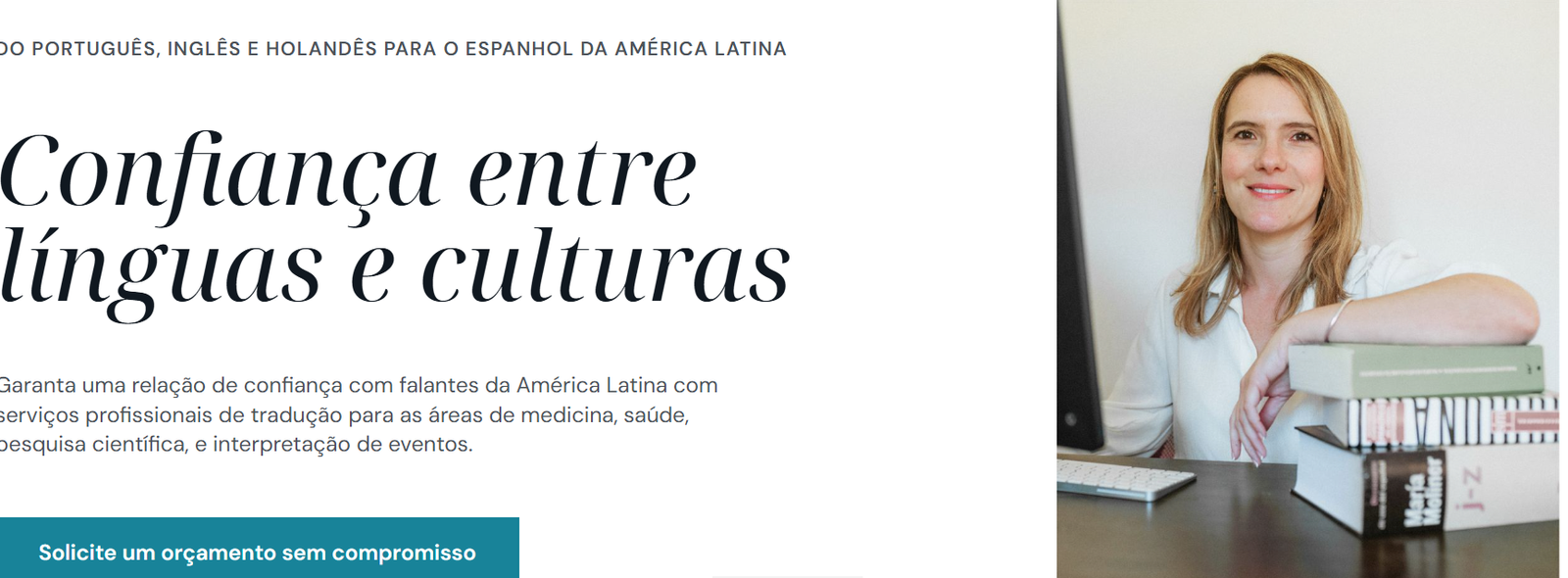
Before: Source pages


Research & Cultural Insights
Understanding the Brazilian Market
Through competitive analysis and cultural research (including insights from "The Culture Map"), I identified key differences in how Brazilians approach hiring translators and interpreters:
Cultural preferences:
- Higher need for authority signals - Credentials, institutional affiliations, and professional proof points matter more
- Visual proof of professionalism - Photos showing actual work (in interpretation booths, accompanying clients, professional equipment)
- WhatsApp as primary contact method - Not just email
- Relationship-based trust - Personal connection and cultural understanding valued alongside technical expertise
- Search behavior - Brazilians commonly search for "tradução simultânea" (simultaneous translation) rather than the technically correct "interpretação" (interpretation)
Competitive Analysis
I analyzed competitor websites in Brazil to identify:
- Standard information architecture for interpretation services
- Common service descriptions and use cases
- Gaps and opportunities in the market
- How Brazilian interpreters position themselves
Key findings:
- Most sites lacked clear use case descriptions
- Equipment and setup information was rarely detailed
- Remote interpretation capabilities weren't well-explained
- Few sites effectively communicated cultural mediation as a value proposition
Strategy & Approach
Positioning Strategy
The core strategic question: How do we position a Uruguayan interpreter in the Brazilian market?
The answer: Turn her binational experience into a competitive advantage.
Positioning pillars:
- Cultural bridge - Native Spanish speaker with deep Brazilian experience
- Technical excellence - 14+ years specializing in medical/health fields
- Institutional credibility - Former professor at UnB (Universidade de Brasília), a prestigious institution
- Dual expertise - Ideal for Brazilian companies doing business in Uruguay/Latin America, and international events requiring Portuguese-Spanish interpretation
Target audiences identified:
- International event organizers in Brazil
- Brazilian companies expanding to Uruguay/Latin America
- Medical conferences and pharmaceutical companies
- Diplomatic and executive meetings requiring Portuguese-Spanish interpretation
Content Strategy & Adaptation
Tone Transformation
Before (English site): Professional, formal, matter-of-fact
After (Brazilian Portuguese): Conversational, warm, authoritative but approachable
Inés gave me carte blanche to rewrite the content to better attract the target audience. The new tone balances technical expertise with cultural warmth—essential for the Brazilian market.
Search Optimization for Brazilian Behavior
Discovered through research: Brazilians commonly search for "tradução simultânea" (simultaneous translation) instead of the technically correct term "interpretação" (interpretation).
Solution: Used both terms strategically throughout the site.
H1: "Interpretação (tradução simultânea)"
Throughout content: Naturally incorporated both terms with explanations like "geralmente conhecido como..." (commonly known as...)
This approach:
- Improves discoverability for how Brazilians actually search
- Educates visitors on correct terminology
- Doesn't compromise professional credibility
Key Localization Decisions
Language Choices
"Tradução simultânea" vs. "Interpretação"
- Used both terms to match search behavior while educating
- Primary headers use both: "Interpretação (tradução simultânea)"
- Content naturally explains the difference
Formal vs. Conversational Balance
- More conversational than the English original
- Maintains authority through expertise demonstration
- Warm but professional—reflecting Brazilian communication style
Cultural Adaptations
Authority signals for Brazilian audience:
- UnB professorship prominently featured
- Detailed equipment and preparation descriptions
- Step-by-step process explanations
- Institutional client testimonials
Relationship-building elements:
- WhatsApp contact option
- Personal pronouns and direct address
- Photo showing Inés in professional contexts
- Emphasis on being a "parceira de confiança" (trusted partner)
Market-specific value proposition:
- "455 million Spanish speakers" positioned as opportunity for Brazilian businesses
- Cultural bridge positioning: "native Spanish speaker with Brazilian experience"
- Emphasis on avoiding communication failures in international partnerships
Case Study Highlight: The Interpretation Page
Of all the pages transformed, the interpretation page best exemplifies effective localization because it required:
Strategic additions:
- Three interpretation type explanations with specific use cases
- Remote event materials section (addressing post-pandemic reality)
- Expanded FAQ addressing Brazilian client objections
- Detailed workflow showing professional preparation
Cultural adaptation:
- Use of "tradução simultânea" terminology
- Authority signals (equipment specs, backup systems)
- Relationship-building language
- Visual proof through photos
Market repositioning:
- From secondary service to primary offering
- From general description to specific use cases
- From basic information to comprehensive client education
This page demonstrates that localization isn't about changing everything—it's about making strategic changes that resonate with the new market while maintaining core brand integrity.
[VISUAL SUGGESTION: Full-page screenshot of the interpretation page or key sections highlighted]
Most Significant Changes
This page underwent the most extensive transformation as interpretation became the primary service focus for the Brazilian market.
Added sections:
- "Quando contratar uma intérprete?" (When to hire an interpreter)
- Simultaneous interpretation use cases: large conferences, press conferences, multilingual webinars
- Consecutive interpretation use cases: meetings, negotiations, interviews, training sessions
- Liaison/escort interpretation: business visits, factory tours, social events
- "Materiais de trabalho para eventos remotos" (Remote event work materials)
- Ultra-fast internet (420 Mbps) with backup connection
- Backup hardware (headphones, microphones, laptops)
- Uninterruptible power supply (UPS) protection
- Experience with Zoom, Webex, Microsoft Teams, Google Meet
- Expanded workflow explanation
- Detailed 5-step process from initial contact to event day
- Emphasis on preparation and partner interpreter coordination
- Technical setup and sound checks for professionalism
- Enhanced FAQ section
- "Por que não posso usar uma pessoa bilíngue ou a IA?" (Why can't I just use a bilingual person or AI?)
- "Não é só usar inglês na reunião?" (Why not just use English in the meeting?)
- "Por que preciso de dois intérpretes?" (Why do I need two interpreters?)
- "Intérpretes precisam se preparar para eventos?" (Do interpreters need to prepare for events?)
These additions directly addressed Brazilian clients' lack of understanding about interpretation services and preemptively answered objections.
Project Credits
Localization & Copywriting: [Your Name]
Client & Subject Matter Expert: Inés Meirelles
Professional Review: Kelly Oliveira
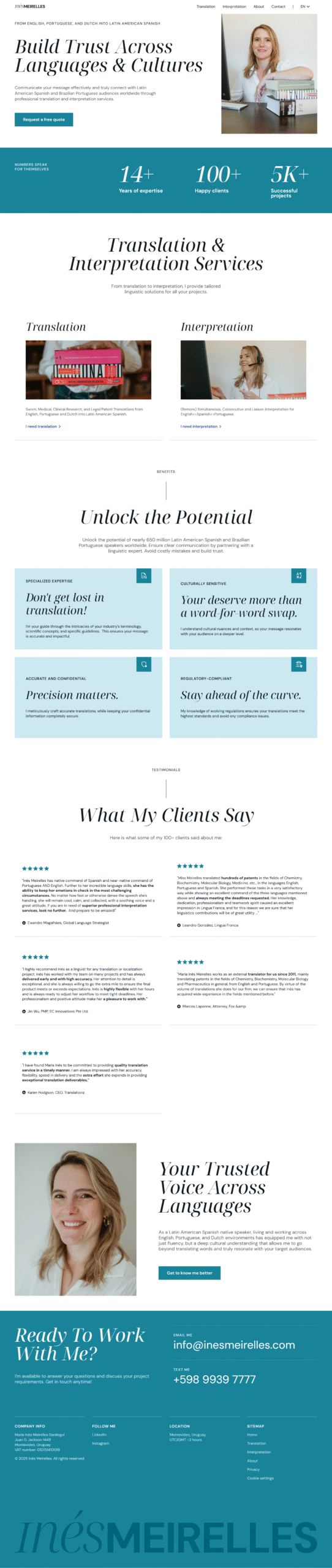
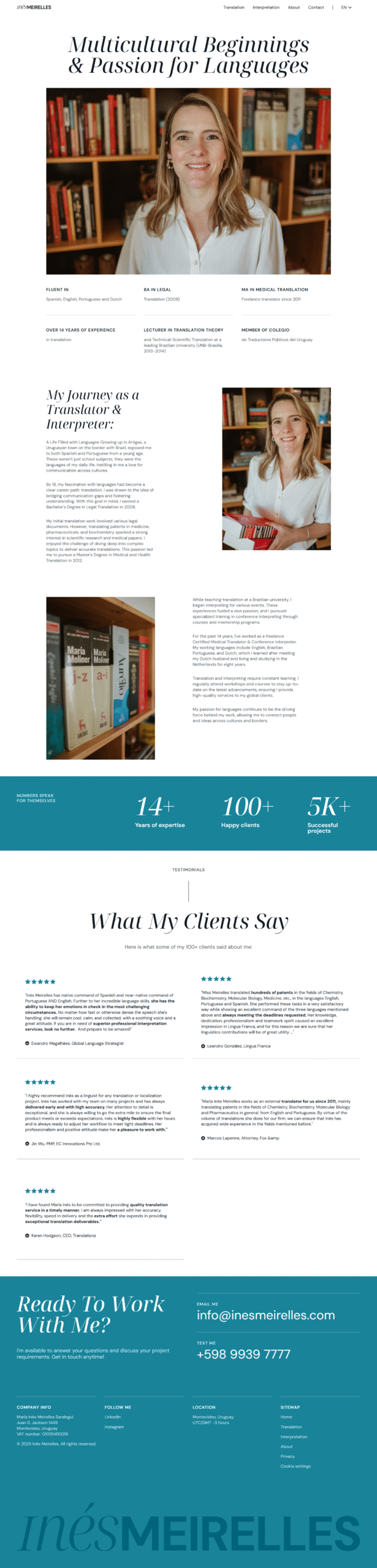
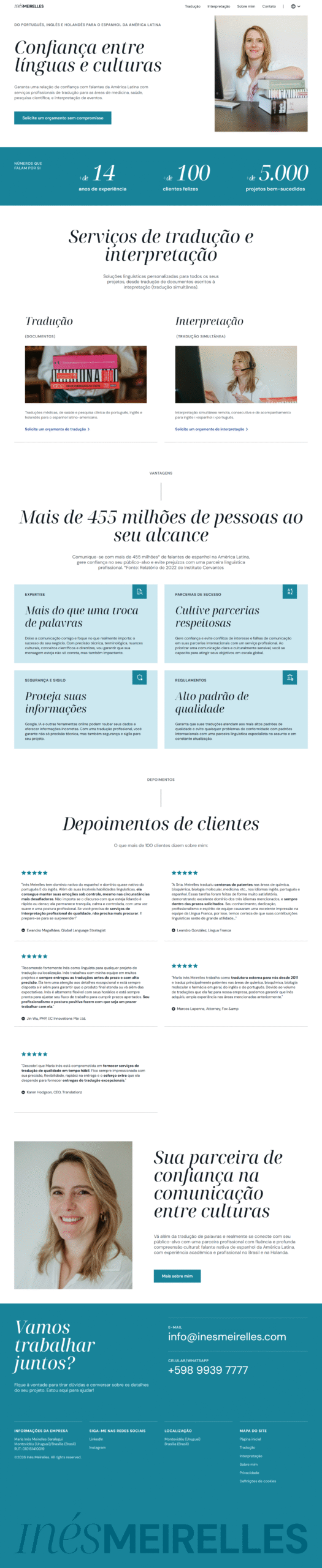
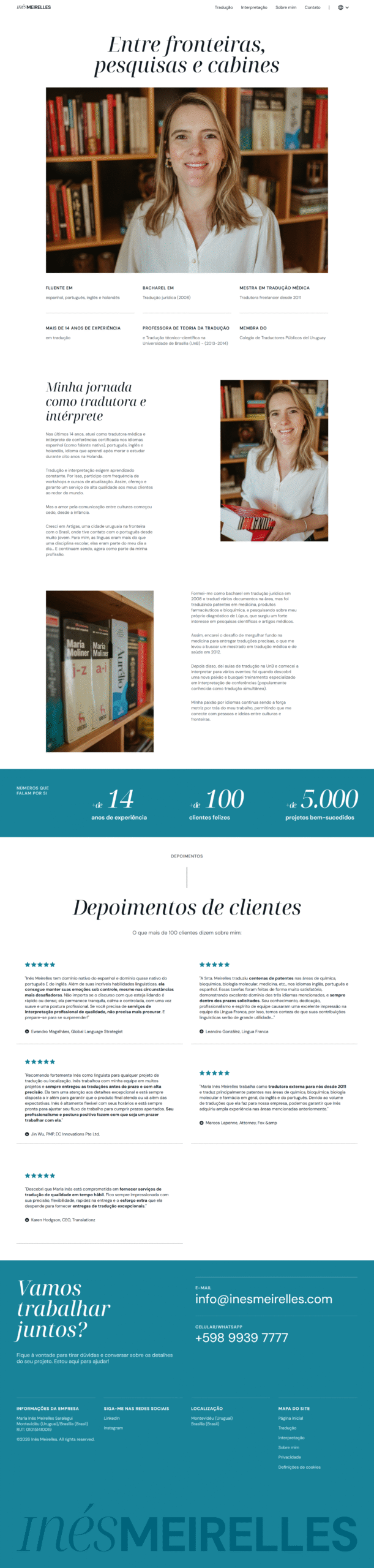
After: new copy adapted for Brazil


You may also be interested
in these projects
Check out more projects below or click on "View all" to see all my work samples.